|
 view full-size screenshot |
If you want to get a small bit of information on the processes and
applications loaded into your PC's memory, including sniffers and hooks, look
carefully in AATools Process Monitor (ProcMon).
AATools ProcMon is the useful tool for identifying hidden applications, killing running
processes, and managing the usage of your PC’s resources more effectively. At
least you'll have an idea what is currently running on your PC.
Instant Download
|
To determine if your
system has been compromised
just run the Process Monitor
utility from the AATools to
see the list of the
processes (applications and
services) that are currently
running on your computer.
You have to identify if all
the programs are approved
and you do not have any
hidden application running
behind your back.
Be careful when ending a process. If you end an
application, you will lose unsaved data. If you end a system service, some part
of the system may not function properly.
Working with AATools ProcMon
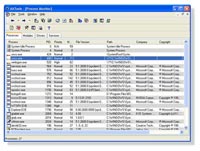
The Main window of Process Monitor contains 4 tables: Processes, Modules, Drivers
and Services (only on Windows NT/2000/XP). Process Monitor shows all the specific
information about the selected process. Module list shows the modules used by the
selected process. Drivers list shows all the drivers on your computer.
Processes
Shows all the processes currently running on your PC. The Processes frame is present
as a table with the following columns: Process (shows the process name), PID (shows
the unique process ID), Modules (shows the number of modules used by the selected
process), File version (shows the file version of the running process), Path (shows
the full path to the program’s executable file), Company (shows the name of the file
manufacturer), Copyright, Description (displays a short description of the running
process).
Modules
Shows all the modules used by the selected process. The Modules frame is present
as a table with the following columns: Modules (shows the name of the selected module),
File version (shows the file version of the running process), Path (shows the full
path to the selected module), Company (shows the name of the module manufacturer),
Copyright, Description. If a selected process has no modules, this frame is not available.
Drivers
Shows all the drivers on your computer. The Drivers frame is present as a table with
the following columns: Driver (shows the name of the appropriate driver), ID (shows
the unique ID of the appropriate driver), Path (shows the full path to the appropriate
driver).
Services
Using Services, you can start, stop, pause, or resume services on remote and local
computers, and configure startup and recovery options. You can also enable or disable
services for a particular hardware profile. The Services frame is present as a table
with the following columns:
Name - shows the name of the appropriate service.
Path - shows a fully qualified path to the service binary file.
Status - shows the status of the appropriate service: started or stopped. When the
service is stopped the appropriate field is blank.
Startup Type - shows when to start the service. AUTO START - specifies a device driver
or service started by the service control manager automatically during system startup,
BOOT START - specifies a device driver started by the system loader, DEMAND START
- specifies a device driver or service started by the service control manager , DISABLED
- specifies a device driver or service that can no longer be started, SYSTEM START
- specifies a device driver started by the IoInitSystem function.
Log On As - shows the name of the ordering group of which this service is a member.
Dependencies - shows names of services or load ordering groups that must start before
this service. Dependency on a service means that this service can only run if the
service it depends on is running. Dependency on a group means that this service can
run if at least one member of the group is running after an attempt to start all
members of the group.
|